

Skin whitening is generally safe when you stick to evidence-based ingredients used at appropriate concentrations and avoid the ones that have been banned for good reason. The safest approach combines a low-strength tyrosinase inhibitor (kojic acid 1–2%, alpha arbutin, or topical tranexamic acid) with daily SPF 30+ and the expectation of gradual lightening & brightening over 8–16 weeks. These products are generally safe but if you have sensitive skin, self-patch skin testing is always recommended. How do you do this? Apply a small amount of whatever product on your antecubital area (this is the small area on your arm that you can easily fold when flexing), then walk around for 15 to 30 mins. If there’s no reaction whatsoever, you can buy that product. However, if there’s itchiness and redness, immediately stop because it can cause further damage and possible scarring.
Walk down the skincare aisle in any country where skin whitening is popular — Manila, Lagos, Mumbai, Bangkok, Los Angeles — and you'll find shelves of creams, soaps, capsules, and spray vials promising more radiant, brighter, even skin. You'll also find unmarked jars on Facebook Marketplace, knockoffs on eBay, and products from sellers whose websites disappear the week after you buy. Some of them work but some of them do nothing. A small but troubling number of them are dangerous.
The conversation about skin lightening tends to get loud quickly — wrapped up in colonialism, beauty standards, identity, and family politics. This guide isn't about any of that. It's about the science: which ingredients actually cause whitening and what to avoid that can cause more harm than good and what to realistically expect if you commit to a routine for the next three to four months.
As we have extensive safety and medical supervision, everything you read here is factual, evidence-based and written with and approved by a board certified dermatologist. Information we cite includes published sources for every claim or conclusion. If you're new to the category, start at the top. If you already know the basics, skip to the ingredient guide.
What "skin brightening" actually means
The three terms — whitening, lightening, and brightening — are often used interchangeably in marketing, but they describe slightly different goals.
Whitening, in the context of skincare, usually means reducing the overall amount of melanin produced in the skin. Lightening is closer in meaning but is more often used to treat specific dark spots, sun damage, or post-acne marks. Brightening is the gentler word — it usually refers to making skin look more radiant and even-toned with reduced pigment as a secondary benefit. A vitamin C serum, for example, is almost always marketed as brightening, even though it can have a real lightening effect over time.
What none of these terms should imply is bleaching. The active ingredients reviewed below don't bleach skin the way a household cleaner bleaches fabric. They slow or interrupt melanin production — the natural pigment your skin makes in response to UV, hormones, and inflammation — so that gradual cell turnover replaces darker pigmented cells with lighter ones. Results are partial. They build slowly. They can reverse if you stop using sunscreen.
That distinction matters because it shapes realistic expectations. If you go in expecting your skin to lighten by several shades in a few weeks, you'll be disappointed by any honest product. Realistic expectations of one- or two-shade gradual evening of your tone over a few months, with the dark spots fading first and your overall complexion looking brighter and more uniform. Those results are readily achievable, but some people see faster results, it’s partially genetic and other factors but your goal should be quality of results even if it takes a bit longer. It’s always reasonable to assume you will fall within results that published research supports.
A quick word on melanin
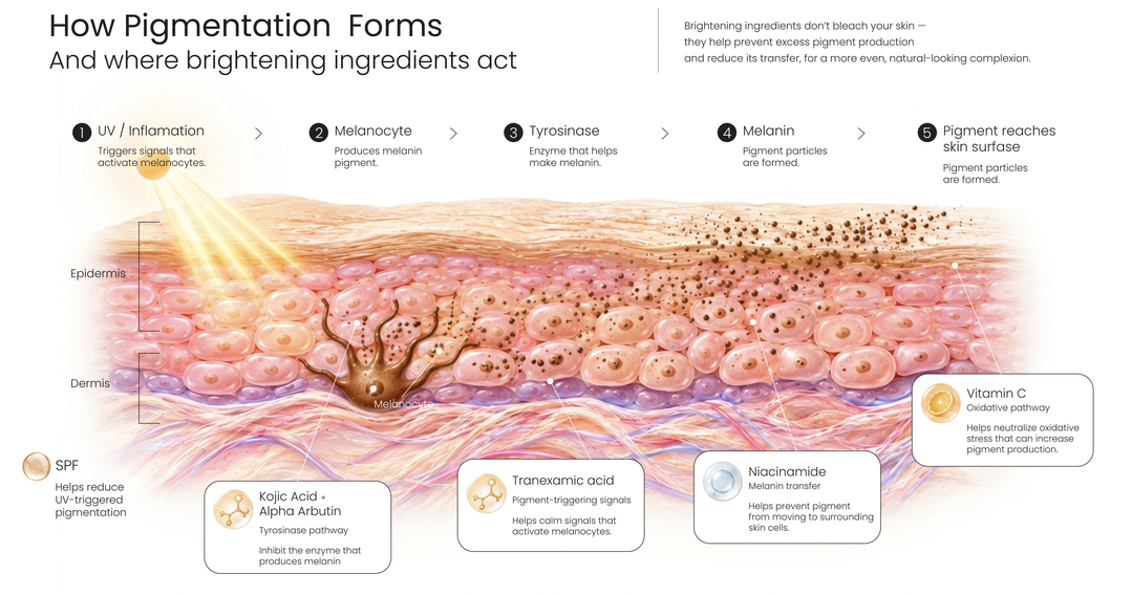
Melanin is the pigment that gives your skin, hair, and eyes their color. It's produced inside melanocytes — specialized cells that sit at the base of the epidermis — and then handed off to surrounding skin cells, where it travels to the surface and is eventually shed. The whole cycle takes about four to six weeks.
Every melanin molecule starts the same way: a single enzyme called tyrosinase converts the amino acid every legitimate skin-lightening ingredient works by interfering with this process — either by inhibiting tyrosinase directly (kojic acid, alpha arbutin, hydroquinone), by reducing the signals that activate melanocytes (tranexamic acid, niacinamide), or by neutralizing the oxidative reactions that drive melanin production (vitamin C, glutathione).
Knowing this is useful because it explains why most effective routines combine two or three of these mechanisms rather than relying on a single ingredient at high strength. It also explains why daily SPF is non-negotiable: every minute of unprotected UV exposure tells your melanocytes to ramp production back up, undoing whatever the rest of your routine just did.
Ingredients that are safe and effective
Here are the active ingredients that have been studied in humans, are available over the counter or by prescription in the United States and most other countries and have a reasonable safety record at the concentrations recommended below.
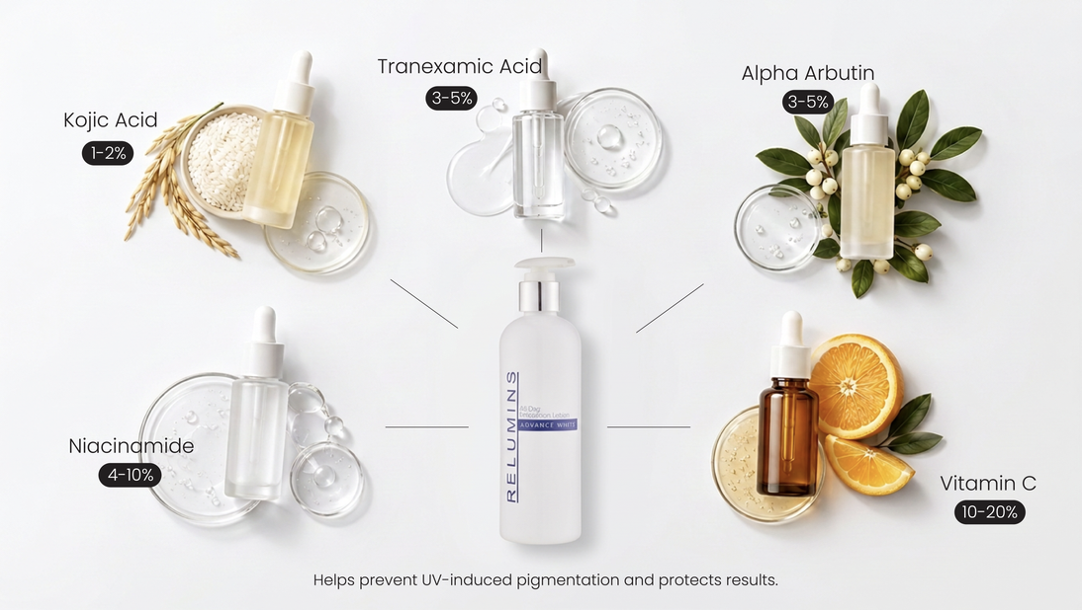
Kojic acid (1–2%)
Kojic acid is a byproduct of fermenting rice (the same process used to make sake) and was originally isolated in Japan. It works by inhibiting tyrosinase, the gateway enzyme in melanin production. A 2% concentration is the dose most studies use, and it has been shown to produce results comparable to those of 2% hydroquinone for melasma and hyperpigmentation. Strengths below 1% may not move the needle.
Side effects to watch: kojic acid can cause contact dermatitis, especially in sensitive skin or at higher concentrations. Always self-patch test on the inner forearm for 15 to 30 mins. If there’s no itchiness nor redness, you may apply it on the face. Unlike hydroquinone, it doesn't carry the risk of paradoxical darkening with long-term use, making it a reasonable choice for routine maintenance.
You'll most commonly find kojic acid in soaps, body lotions, and spot-treatment serums. It works best when paired with another tyrosinase inhibitor and used twice daily with consistent sun protection.
Topical tranexamic acid (3–5%)
Tranexamic acid is the newer kid on the skin-whitening block. Originally developed as an oral anti-clotting medication, it turned out to have a useful side effect: it interrupts the inflammatory signal (the plasminogen-plasmin pathway) that tells melanocytes to ramp up production. That makes it especially effective for melasma and stubborn hormone-driven pigmentation that doesn't respond to tyrosinase inhibitors alone.
Topical tranexamic acid is generally well tolerated even on sensitive skin. Recent randomized trials have shown that 3% topical tranexamic acid yields results comparable to those of 4% hydroquinone — without the prescription requirement or long-term safety concerns. Combination therapies that pair tranexamic acid with laser treatment have shown even stronger results in meta-analyses.
Oral tranexamic acid is also used for severe melasma, but only under medical supervision due to the (rare) risk of blood clotting. Don't self-prescribe oral tranexamic acid.
Alpha arbutin (1–2%)
Alpha arbutin is a stable, water-soluble form of hydroquinone's chemical cousin. It's gentler than kojic acid and works similarly — inhibiting tyrosinase. The trade-off for that gentleness is slower visible results. Most users notice improvement after 8–12 weeks of twice-daily use, whereas kojic acid often produces noticeable results in 6–10 weeks.
Alpha arbutin is a good choice if you've reacted poorly to kojic acid or hydroquinone in the past, or if your skin tends toward redness and sensitivity. It pairs well with vitamin C in the morning and a retinoid at night, if your skin tolerates retinoids.
Niacinamide (4–10%)
Niacinamide is a form of vitamin B3 that, at concentrations of 5% or higher, has been shown in controlled studies to reduce hyperpigmentation. It doesn't work by inhibiting tyrosinase directly — instead, it interferes with the transfer of melanin from melanocytes to surrounding skin cells. The result is the same: less pigment makes it to the surface.
It's an excellent supporting ingredient because it also strengthens the skin barrier, reduces redness, and is well tolerated by almost everyone, including pregnant and nursing women. Most evidence-based brightening serums and moisturizers include niacinamide as a foundation ingredient.
Vitamin C / L-ascorbic acid (10–20%)
Stabilized L-ascorbic acid is the form of vitamin C with the most clinical evidence. It acts as an antioxidant, neutralizing free radicals generated by UV exposure that drive melanin production, and it directly inhibits one of the downstream steps in melanin synthesis. Expect gradual brightening rather than dramatic lightening.
Vitamin C is best applied in the morning under SPF, because the antioxidant effect compounds with sun protection. However, if you have oily or acne prone skin, you may apply this at night only. It's fussy — it oxidizes when exposed to light, air, and time — so look for opaque or amber packaging and use the bottle within three months of opening. Browning or darkening of the serum is a sign that it's no longer working.
Glutathione (oral, sublingual, IV)
Glutathione deserves its own guide, and we've written one — see <em>Glutathione for Skin Whitening: The Complete Guide</em> [link to pillar]. The short version: glutathione is the body's master antioxidant, and at supplementary doses it shifts melanin production toward the lighter pigment (pheomelanin) rather than the darker one (eumelanin). Published clinical trials show that 500 mg of oral glutathione taken daily for 12 weeks produces measurable skin lightening on the face and forearms.
Ingredients to use with caution
These ingredients are effective but carry enough trade-offs that you should think carefully before incorporating them.
Hydroquinone (2–4%) — now prescription-only in the US
Hydroquinone has been the gold standard for treating hyperpigmentation for decades, and it's still considered the most effective single ingredient for melasma in much of the world. But its over-the-counter sale was effectively banned in the United States under the CARES Act in 2020. It's still legal — and effective — when prescribed by a dermatologist, typically at 4% strength.
The reasons for the restriction include the risk of ochronosis — a paradoxical bluish-black darkening of skin that occasionally develops with long-term high-concentration use — and concerns about systemic absorption. Most dermatologists who prescribe hydroquinone limit its use to 12-week cycles, alternating with kojic acid or tranexamic acid for maintenance.
If you're outside the US, hydroquinone may still be available without prescription at 2% or lower. Stick to short courses (no more than three months at a time) and don't combine it with peroxide-based products, which can deactivate them.
<strong>Important warning:</strong> there's a documented pattern of imported skin-lightening creams sold in ethnic beauty stores that contain hydroquinone at undisclosed strengths — sometimes well above what's considered safe. A 2024 study of 70 stores in the Twin Cities found prescription-strength hydroquinone in products labeled for over-the-counter use, often without ingredient disclosure on the label. Buy from established retailers with traceable sourcing.
Retinoids (tretinoin, adapalene, retinol)
Retinoids accelerate cell turnover, which helps fade existing pigmented cells more quickly and also makes other lightening ingredients more effective. The trade-off is that retinoids cause irritation, dryness, and sun sensitivity — particularly in the first 6–8 weeks of use. They also can't be used in pregnancy.
If your skin tolerates them, retinoids are an excellent addition to a lightening routine. Start with a low-strength OTC retinol (0.3% or below) two nights a week and build up gradually. Always pair with daytime SPF — retinoid-treated skin burns more easily.
Ingredients to avoid completely
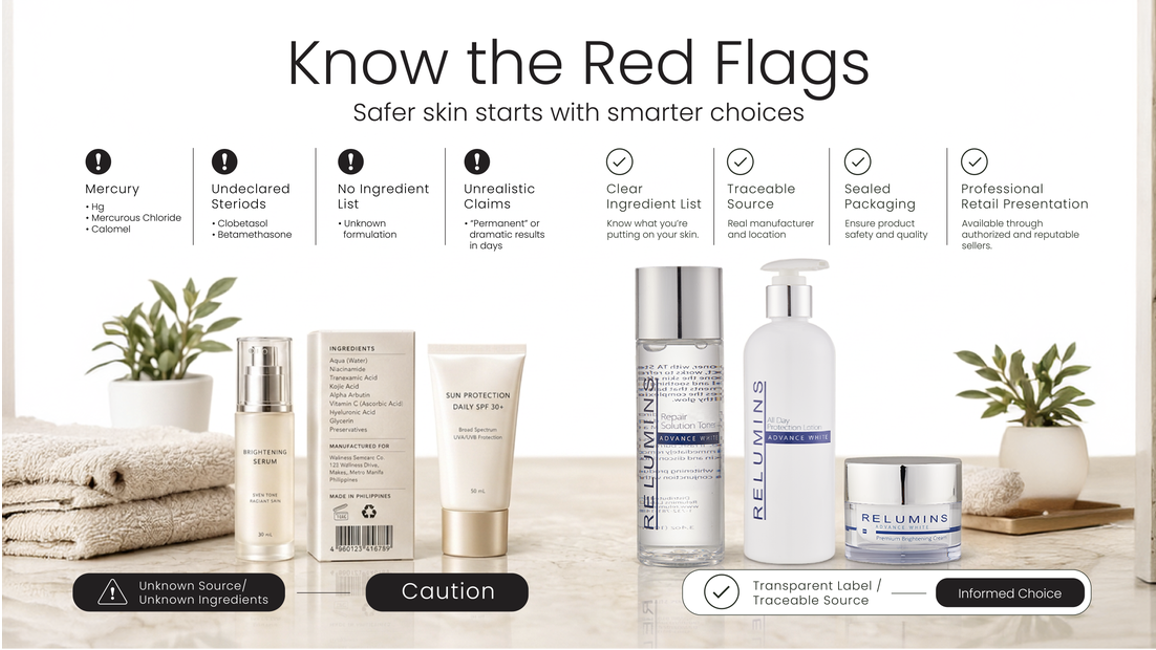
This is the section we wish we didn't have to write. But the unfortunate reality is that some of the most popular skin-whitening products sold informally — in unmarked jars, through social media sellers, or in unverified ethnic beauty stores — contain ingredients that have been banned by health regulators around the world. Some of them are dangerous enough that the FDA can confiscate the products and prosecute the sellers.
Mercury (any form)
Mercury-containing skin-lightening creams are banned in the United States and most other developed economies. They are also, unfortunately, still in circulation — particularly in imports from parts of Asia and Africa. The FDA's Skin Facts! initiative specifically alerts consumers about mercury in skin products.
On the ingredient label, mercury can appear as mercurous chloride, calomel, mercuric, mercurio, or simply <strong>Hg</strong>. It can also appear under no name at all — many of these products don't list ingredients accurately, or any ingredients at all.
The harm is real and well-documented. Chronic mercury exposure causes kidney damage, neurological symptoms (tremors, memory issues, mood changes), skin rashes, and discoloration. Mercury exposure during pregnancy can permanently affect the fetus's developing brain. Nursing women pass mercury to infants through breast milk. The FDA describes these products as having the potential to cause <em>"serious and irreversible harm."</em>
If you have a product whose origin you can't verify, whose ingredient list is missing or in another script, or which you got from a non-traditional seller — stop using it. If you've used it for a while and are concerned, see a doctor for a urine mercury test.
Undeclared steroids (clobetasol, betamethasone)
Some unregulated whitening creams contain potent corticosteroids — usually clobetasol or betamethasone — added because they produce a fast, dramatic-looking lightening effect by thinning the skin and reducing blood flow. The result looks good for a few weeks and then catches up with you: permanently thinned skin, visible blood vessels, stretch marks, rebound darkening worse than the original, and steroid acne. Topical steroids are absorbed systemically, especially when applied to large areas or thin facial skin, and can suppress the body's natural cortisol production.
Undeclared steroid creams are particularly common in informal Asian and African skincare markets. If a cream produces noticeably lighter skin in days rather than weeks, it almost certainly contains a steroid (or mercury, or both). Stop using it and see a dermatologist if you've used it for any length of time.
Other red-flag ingredients
Less common but worth knowing: monobenzyl ether of hydroquinone (monobenzone) is sometimes found in informal whitening products and produces permanent depigmentation — useful for treating vitiligo, dangerous as a routine whitening agent. High-concentration phenol peels sold for at-home use carry a risk of burns and scarring. Anything called a "glutathione injection" sold for at-home self-administration shouldn't be — only sterile, properly compounded IV glutathione delivered in a clinic setting is acceptable.
How long it takes and what to realistically expect
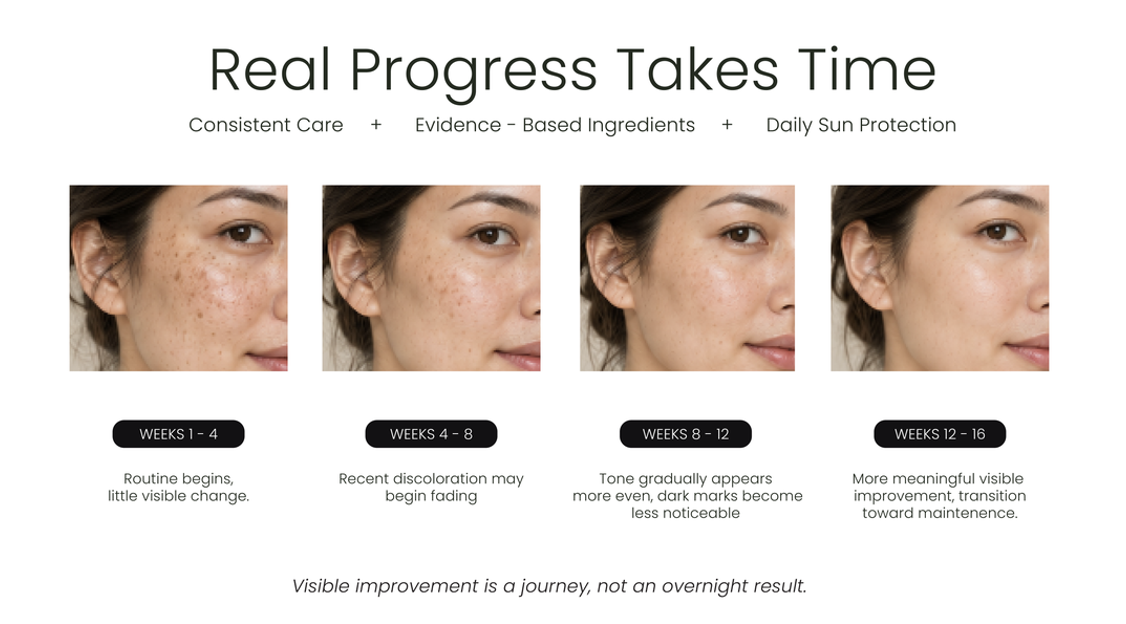
Honest timelines, based on what the published studies actually measured:
Weeks 1–4.</strong> No visible change. Your skin may feel different — slightly more sensitive, possibly drier — as new ingredients take effect. Stick with it. Take a baseline photo in natural light for comparison
Weeks 4–8.</strong> Discoloration from recent sun exposure or post-acne marks begins to fade first. Existing deeper pigmentation (sunspots, melasma) starts to look slightly less defined. Most users notice that the dullness in their complexion has lifted.
Weeks 8–12.</strong> Sunspots and post-acne marks are visibly lighter. The overall tone is more even. Melasma may show modest improvement but is the slowest to respond. This is when before-and-after comparison photos start to look meaningful.
Weeks 12–16+.</strong> Maximum visible result from a consistent routine. A typical outcome at this point is one to two shades of overall lightening and substantial fading of focal hyperpigmentation. Beyond this point, gains plateau — ongoing use shifts from active treatment to maintenance.
If you stop the routine, expect pigmentation to gradually return over the following 3–6 months unless you maintain religious SPF use. Most people who get good results from skin-lightening routines stay on a modified maintenance version indefinitely.
Sunscreen is the most important step
Every dermatologist who treats hyperpigmentation will tell you the same thing: your sunscreen is your most important lightening product. Without it, every other ingredient is fighting an uphill battle, and the moment you skip a few days of SPF, you give back whatever ground you've gained.
What to look for in a sunscreen for skin-lightening routines:
*Broad-spectrum (UVA and UVB protection)
*SPF 30 minimum, SPF 50 ideal for face
*Mineral (zinc oxide, titanium dioxide) is preferred for sensitive or melasma-prone skin
*Tinted formulas with iron oxides offer additional protection against visible-light-induced melasma
*Reapply every two hours of outdoor exposure
Sunscreen needs to be on your face before makeup, every single morning, including cloudy days and indoor days near windows. Visible light from screens can also worsen melasma — tinted SPF formulas help.
When to see a dermatologist
Some signs that an over-the-counter routine isn't the right path:
*Hyperpigmentation that's growing or changing shape (rule out other conditions)
*Severe melasma that hasn't responded to 12+ weeks of consistent OTC treatment
*Persistent acne that's leaving new dark marks faster than you can fade old ones
*Sudden onset of pigmentation in adulthood (hormonal workup may be warranted)
*Any skin reaction — burning, blistering, severe peeling — to a product you've been using
A dermatologist can prescribe higher-strength hydroquinone, write a triple-combination formula (the Kligman regimen), perform chemical peels or laser treatments, and screen for medical conditions like thyroid disease or hormonal imbalance that might be driving the pigmentation.
At-home topicals vs IV vs in-office treatments
If you're newer to the category, start at home with the ingredient guide above. Topical routines are the safest, cheapest, and most evidence-backed first step. Give them 12–16 weeks of consistent use before deciding they don't work.
IV glutathione can produce faster results — typically visible in 4–6 weeks rather than 8–12 — but it requires clinic visits, has a higher cost per session, and should only be done with sterile, compounded glutathione administered by trained practitioners. See our <em>Glutathione for Skin Whitening: The Complete Guide</em> [link] for the full breakdown
In-office procedures</strong> — chemical peels, microneedling with brightening serums, low-energy lasers — can speed results for resistant pigmentation but generally work best alongside, not instead of, a solid at-home routine. For melasma specifically, lasers can paradoxically worsen pigmentation, so make sure your provider has melasma-specific experience.
Buying products you can trust
The single biggest determinant of whether a skin-lightening product is safe is where you buy it. If you stick to established retailers with traceable sourcing and brand-authenticity verification, you avoid the entire mercury/undeclared-steroid/counterfeit problem in one move.
What to look for in a retailer:
*Verifiable authorized retailer status from the brand (most legitimate brands publish their authorized retailer list)
*Full ingredient disclosure on every product page
*Country-of-origin labeling and proper FDA registration were required
*A return policy and a real customer support address — not just a contact form
*Reviews that look like real customers, not bot-generated
Avoid social-media-only sellers, unmarked product photos, prices that seem dramatically lower than what's offered elsewhere, and any product whose ingredient label is missing, in a script you can't read, or whose claims include the word "permanent."
Frequently asked questions
Is skin whitening safe?
When you use evidence-backed ingredients (kojic acid, tranexamic acid, alpha-arbutin, vitamin C, niacinamide, glutathione) at the concentrations used in published research, and you protect your skin daily with SPF 30+, skin whitening is generally safe. Where it stops being safe is with banned ingredients (mercury), undeclared steroids, prescription-strength hydroquinone bought without a dermatologist's supervision, or products from sources whose ingredients you can't verify.
What's the safest skin whitener?
For routine over-the-counter use, the safest evidence-based options are kojic acid at 1–2% and alpha-arbutin at 1–2%. Topical tranexamic acid at 3% is also safe and especially effective for melasma. All three work best paired with niacinamide, vitamin C in the morning, and daily SPF 30+.
Is skin whitening permanent?
Any product that claims permanent results is misrepresenting how skin biology works. Skin lightening from topical ingredients lasts as long as you maintain the routine and protect your skin from UV exposure. If you stop, pigmentation gradually returns over the following 3–6 months.
Can you whiten skin naturally?
There are some natural ingredients with mild lightening properties — niacinamide, vitamin C, mulberry extract, licorice extract — but "natural" doesn't necessarily mean stronger or safer. The most effective evidence-backed ingredients are bioidentical or naturally derived (kojic acid is derived from fermented rice, alpha-arbutin comes from bearberry, vitamin C is a vitamin), but at concentrations and stability profiles that home preparation can't reliably reproduce.
What ingredients should you avoid in whitening creams?
Mercury in any form (mercurous chloride, calomel, Hg), undeclared steroids (clobetasol, betamethasone), monobenzone, and high-concentration hydroquinone outside of dermatologist supervision. Also avoid any product with no ingredient list, an ingredient list you can't read, or claims that seem unrealistic ("7 shades lighter in 2 weeks").
Is hydroquinone safe?
Hydroquinone at 2–4% is the most clinically established skin-lightening ingredient and is generally safe when used under a dermatologist's supervision. The CARES Act of 2020 effectively removed it from over-the-counter sale in the United States because of concerns about long-term use, undisclosed-concentration products, and the risk of ochronosis. If your dermatologist prescribes it, follow the use-cycle guidance — typically no more than 12 weeks at a time.
What's the difference between whitening, lightening, and brightening?
Marketing-wise these terms are often interchangeable. Functionally, whitening usually implies overall melanin reduction, lightening usually refers to specific dark spots, and brightening is the gentlest term — implying a more radiant, even look without necessarily reducing pigment significantly. Vitamin C is typically called brightening; kojic acid is typically called lightening or whitening.
Why do my dark spots get worse in summer?
Because UV exposure directly stimulates melanocytes to produce more melanin. Even with an active lightening routine, spending time in the sun without rigorous SPF undoes weeks of progress. Tinted mineral SPF with iron oxides offers additional protection against visible light, which can drive melasma.
How do I know if my skin-whitening product is fake?
Look for ingredient transparency, brand authenticity verification (holograms, scratch-off codes, registered trademark symbols), country-of-origin labeling, and authorized retailer status. Avoid social-media-only sellers and any product priced dramatically below the brand's stated retail price. See our brand-specific authenticity guides for Relumins, Dalfour Beauty, and Kojie San.
The bottom line
Safe skin whitening exists. It just doesn't look as dramatic as the social-media ads promise. A consistent routine of kojic acid or tranexamic acid, layered with niacinamide and vitamin C, supported by daily SPF 30+, and given 12–16 weeks to work — that's the formula that the published research backs up. It will give you a one- to two-shade improvement and noticeably more even tone. It will keep you safe. It will not work overnight, and it will not work if you cut corners on sunscreen.
If your current product is producing dramatic results in weeks instead of months, or has no ingredient list, or came from a source you can't trace — stop using it and read the warning signs in the "Ingredients to avoid" section above. The short-term effect is not worth the long-term harm.
And if you're still figuring out where to start: kojic acid soap morning and night, niacinamide serum after washing, SPF 30+ before makeup. That's the entire routine. Add more ingredients only after you've given the basic version 12 weeks.
Sources
U.S. Food and Drug Administration. Skin Facts! What You Need to Know About Skin Lightening Products. fda.gov/consumers/minority-health-and-health-equity/skin-facts-what-you-need-know-about-skin-lightening-products
U.S. Food and Drug Administration. Skin Products Containing Mercury and/or Hydroquinone. fda.gov/consumers/health-fraud-scams/skin-products-containing-mercury-andor-hydroquinone
U.S. Food and Drug Administration. Mercury Poisoning Linked to Skin Products. fda.gov/consumers/consumer-updates/mercury-poisoning-linked-skin-products
Hwang J. et al. Prescription Ingredients in Skin-Lightening Products Found Over-the-Counter Post-Hydroquinone Ban: Cross-Sectional Study of 70 Stores in the Twin Cities. PMC, 2024.
Wang J. et al. Treatment of Melasma with Tranexamic Acid Essence Combined with Iontophoresis: A Randomized, Double-Blind, Placebo-Controlled Clinical Trial. PMC, 2024.
Various. Effectiveness of laser and topical tranexamic acid combination therapy in melasma: An updated systematic review and meta-analysis. PubMed PMID 37326860, 2023.
Heydari et al. Randomized Clinical Trial on the Efficacy of Oral Tranexamic Acid Versus Topical Tranexamic Acid in Treatment of Melasma. Journal of Cosmetic Dermatology, 2025.
Lim H.W., Collins S.A.B., Resneck J.S. Jr., et al. Evidence-based Review, Grade of Recommendation, and Suggested Treatment Recommendations for Melasma. PMC, 2017.
Various. Kojic Acid vis-a-vis its Combinations with Hydroquinone and Betamethasone Valerate in Melasma. PMC, 2013.
Comparison of the Effectiveness and Safety of 5% Cysteamine and 2% Kojic Acid Creams in the Treatment of Melasma. PMC, 2024.
Arjinpathana N., Asawanonda P. Glutathione as an oral whitening agent: a randomized, double-blind, placebo-controlled study. JCAD 2012.
American Academy of Dermatology Association. How dermatologists treat hyperpigmentation.
Also on flawless beauty